2025 Senior Life Solutions Outcomes Report: Advancing Mental Health Care for Older Adults

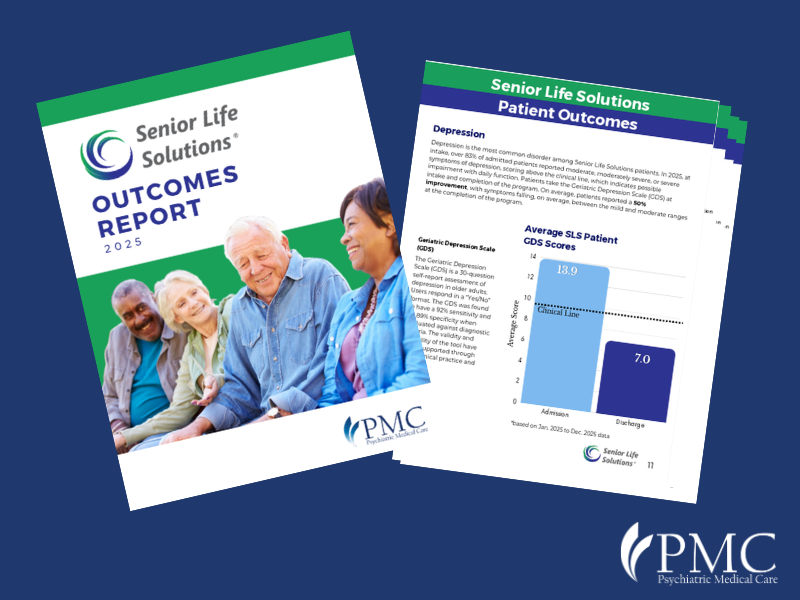
As the U.S. population ages, the demand for effective, compassionate mental health care for older adults continues to grow. The 2025 Senior Life Solutions (SLS) Outcomes Report offers a clear and data-driven look at how targeted, evidence-based interventions can meaningfully improve the lives of seniors facing depression, anxiety, and psychological distress.

Designed specifically to address the unique mental health needs of older adults, Senior Life Solutions delivers a structured, supportive approach to care. These programs are embedded in rural hospitals across the country, where many communities struggle to provide mental health services. Through a combination of group therapy, individual counseling, medication management, and personalized treatment planning, the program focuses not just on symptom reduction but on restoring dignity, connection, and quality of life.

Attention Hospital Leaders!
Find out more about Senior Life Solutions and the behavioral health services Psychiatric Medical Care has to offer. Our fully managed intensive outpatient programs help hospitals deliver the mental health care their communities demand, while generating revenue. Contact Us today.


Download the 2025 Senior Life Solutions Outcomes Report

A Commitment to Measurement and Evidence-Based Care

At the core of the SLS model is a rigorous commitment to clinical measurement. Patients are assessed at multiple points throughout their care journey, starting at intake, during treatment, and upon program completion using widely recognized behavioral health tools:

  • Geriatric Depression Scale (GDS)
  • CORE-10 (Clinical Outcomes in Routine Evaluation)
  • Zung Anxiety Scale

These assessments are used globally and provide a standardized way to evaluate symptom severity, track progress, and ensure that care decisions remain data-informed and patient-centered.


Patient Profile: High Clinical Need at Intake

The 2025 data underscores the significant level of need among seniors entering the program:

  • Over 83% of patients presented with moderate to severe depression at intake
  • A majority also experienced co-occurring anxiety and psychological distress
  • Many patients reported symptoms severe enough to impair daily functioning

This reinforces the importance of accessible, specialized geriatric behavioral health services—and highlights the critical role SLS programs play in community care settings.


Measurable Outcomes That Matter

The outcomes from the 2025 report demonstrate meaningful clinical improvement across all major measures:

Overall Symptom Reduction

  • Patients who completed the program experienced an average 42% reduction in symptoms of depression, anxiety, and distress
  • The average length of stay was 92 days, indicating a structured but time-limited intervention model

Depression Outcomes (GDS)

  • Depression remains the most common condition among SLS patients
  • Patients reported an average 50% improvement in depressive symptoms
  • By program completion, symptoms decreased to the mild-to-moderate range on average
  • The majority of patients graduated in remission from depression

Psychological Distress (CORE-10)

  • Most patients entered the program above the clinical threshold for distress
  • Patients demonstrated an average 54% improvement on the CORE-10
  • Results indicate significant gains in emotional stability and daily functioning

Anxiety Outcomes (Zung Scale)

  • Over 33% of patients reported high levels of anxiety at intake, including physical symptoms such as rapid heart rate, headaches, and gastrointestinal distress
  • Many initially scored in the marked to severe range, indicating functional impairment
  • Patients experienced an average 22% reduction in anxiety symptoms by program completion

Beyond the Numbers: Restoring Quality of Life

While the clinical data is compelling, the broader impact of Senior Life Solutions extends beyond symptom reduction. Improvements in depression, anxiety, and distress translate directly into:

  • Greater independence in daily activities
  • Improved social engagement and connection
  • Enhanced emotional resilience
  • Reduced burden on caregivers and healthcare systems

These outcomes reflect a holistic approach to care, one that recognizes mental health as a foundational component of overall well-being in older adulthood. To find a Senior Life Solutions program near you, visit our SLS locations page.


A Model for the Future of Geriatric Behavioral Health

The 2025 Outcomes Report serves not only as a reflection of program success but also as a roadmap for continued improvement. As demand for geriatric mental health services increases, scalable, evidence-based models like Senior Life Solutions will be essential.

By combining clinical rigor with compassionate care, SLS demonstrates that meaningful recovery is possible at any stage of life.


A Shared Mission

At the heart of Senior Life Solutions is a simple but powerful belief: every senior deserves dignity, connection, and hope.

The insights from this year’s report reinforce that when care is intentional, personalized, and grounded in evidence, outcomes improve and lives change. Seniors who complete this intensive outpatient therapy program feel more connected to others, happier about their lives, and confident in the future. Moving forward, these findings will continue to guide efforts to expand access, enhance care delivery, and improve mental health outcomes for seniors across the country.

Download a PDF version of the 2025 SLS Outcomes Report.

Loneliness in Older Adults Increases Risk of Death Ideation

A recent study highlights the link between loneliness in older adults and an increased risk of death ideation, while suggesting that attending religious services and engaging in social activities may offer protective benefits.

The study, conducted by the Irish Longitudinal Study on Ageing (TILDA) at Trinity College Dublin, sheds light on the growing public health concerns of loneliness and suicidal thoughts among the elderly. Published in Frontiers in Public Health, the research delves into the issue of social isolation and its connection to a “wish to die” (WTD) among older individuals. WTD refers to thoughts or desires that one would be better off dead, a known clinical marker for future suicidal behavior.

Both social disconnection and rising suicide rates among older adults pose significant public health challenges. Prior research has shown that a lack of social relationships, both in structure and function, contributes to thoughts of suicide. However, this study emphasizes that loneliness itself is a particularly strong predictor of WTD, more so than social isolation or living alone. Notably, even after controlling for depression and other forms of social disconnection, loneliness remained a powerful factor in predicting death ideation.

Dr. Mark Ward, Senior Research Fellow at TILDA and the study’s lead author commented on the findings:
“Loneliness and suicide in older adults have reached critical levels. Our study adds to the growing body of evidence showing that loneliness in later life significantly increases the risk of wishing for one’s own death, which is often a precursor to suicidal behavior. However, we also found that participating in religious services and communal activities can serve as protective factors, reducing the likelihood of these negative thoughts.”

Key Findings:

One of the standout conclusions of the research is the protective role that attending religious services plays in reducing death ideation. Among the key findings are:

  • 4% of participants reported having a wish to die within the month prior to the interview.
  • 10% were found to have clinically significant levels of depression.
  • Loneliness emerged as a critical risk factor for death ideation.
  • Regular attendance at religious services and other prosocial activities significantly reduced the likelihood of WTD.

In addition to religious involvement, other forms of intervention, such as cognitive behavioral therapy (CBT), may help alleviate the loneliness that contributes to depression and death ideation.

Dr. Robert Briggs, a Consultant Geriatrician and co-author of the study, stressed the importance of addressing mental health and social isolation in older populations. He noted that “Wish to Die,” a condition strongly associated with future suicide attempts, is closely linked with loneliness and depression. “Engaging in social activities can offer significant protection against these feelings,” Dr. Briggs emphasized, urging policymakers to prioritize mental health and social connectedness in aging populations.

Regius Professor Rose Anne Kenny, Principal Investigator of TILDA, pointed out that loneliness and social isolation have been exacerbated in Ireland, particularly during the COVID-19 pandemic. “Even now, as we emerge from the pandemic, some older adults continue to suffer from isolation, having lost confidence in social engagement. Loneliness accelerates biological aging and worsens health outcomes, making it an urgent issue to address.”

The study underscores the importance of fostering social engagement and providing accessible mental health care to combat loneliness and its associated risks among older adults.

Mental Health Awareness Month, 2024 (Week 1)

Every May (Mental Health Awareness Month) our teams work diligently to stop the stigma and raise awareness of mental illness, and mental health treatments. You might be surprised to learn that 22.8% of US adults have a mental illness. That is almost one out of every four persons. The data for adolescents is even more staggering. 49% of children aged 13 to 18 have a mental illness. These numbers highlight the incredible need for our services across all age groups.

Let’s look at the prevalence of mental illness in America (according to the National Institute of Mental Health https://www.nimh.nih.gov/health/statistics/mental-illness#part_2538):

Any mental illness (AMI) is defined as a mental, behavioral, or emotional disorder. AMI can vary in impact, ranging from no impairment to mild, moderate, and even severe impairment.

Prevalence of AMI:

  • In 2021, there were an estimated 57.8 million adults aged 18 or older in the United States with AMI. This number represented 22.8% of all U.S. adults.
  • The prevalence of AMI was higher among females (27.2%) than males (18.1%).
  • Young adults aged 18-25 years had the highest prevalence of AMI (33.7%) compared to adults aged 26-49 years (28.1%) and aged 50 and older (15.0%).
  • The prevalence of AMI was highest among the adults reporting two or more races (34.9%), followed by American Indian / Alaskan Native (AI/AN) adults (26.6%). The prevalence of AMI was lowest among Asian adults (16.4%).
  • An estimated 49.5% of adolescents had any mental disorder.

Mental Health Services – AMI:

  • In 2021, among the 57.8 million adults with AMI, 26.5 million (47.2%) received mental health services in the past year.
  • More females with AMI (51.7%) received mental health services than males with AMI (40.0%).
  • The percentage of young adults aged 18-25 years with AMI who received mental health services (44.6%) was lower than adults with AMI aged 26-49 years (48.1%) and aged 50 and older (47.4%).
  • Serious mental illness (SMI) is defined as a mental, behavioral, or emotional disorder resulting in serious functional impairment, which substantially interferes with or limits one or more major life activities. The burden of mental illnesses is particularly concentrated among those who experience disability due to SMI.

Severe mental illness (SMI) is defined as a mental, behavioral, or emotional disorder resulting in serious functional impairment, which substantially interferes with or limits one or more major life activities. The burden of mental illnesses is particularly concentrated among those who experience disability due to SMI.

Prevalence of SMI:

  • In 2021, there were an estimated 14.1 million adults aged 18 or older in the United States with SMI. This number represented 5.5% of all U.S. adults.
  • The prevalence of SMI was higher among females (7.0%) than males (4.0%).
  • Young adults aged 18-25 years had the highest prevalence of SMI (11.4%) compared to adults aged 26-49 years (7.1%) and aged 50 and older (2.5%).
  • The prevalence of SMI was highest among AI/AN adults (9.3%), followed by adults reporting two or more races (8.2%). The prevalence of SMI was lowest among Asian adults (2.8%).
  • Of adolescents with any mental disorder, an estimated 22.2% had severe impairment and/or distress. DSM-IV based criteria were used to determine severity level.

Mental Health Services – SMI:

  • In 2021, among the 14.1 million adults with SMI, 9.1 million (65.4%) received mental health treatment in the past year.
  • More females with SMI (67.6%) received mental health treatment than males with SMI (61.3%).
  • The percentage of young adults aged 18-25 years with SMI who received mental health treatment (57.9%) was lower than adults with SMI aged 26-49 years (67.0%) and aged 50 and older (71.0%).

These sobering statistics point out the work still to be done. Let’s use this month to spread awareness and attempt to reduce the stigma surrounding mental illness. Learn more about how Psychiatric Medical Care is improving access to mental health treatment. Our Senior Life Solutions program is a hospital-based intensive outpatient program that helps older adults who are experiencing anxiety, depression and other mental health challenges. Integrated Telehealth Partners provides flexible, cost-effective solutions to hospitals, health systems and jails to ensure patients recieve behavioral health services in a timely manner. Embrace Health offers teletherapy and telepsychiatry services and our new adolescent mental health clinic in Tennessee, Embrace U, provides intensive outpatient therapy programs to children and teens who are experiencing symptoms of a mental health condition.

Newman Memorial Hospital’s Senior Life Solutions Program Named Among Nation’s “Great Psychiatry Programs”

Becker’s Hospital Review included Newman Memorial Hospital’s Senior Life Solutions Program on the first edition of its “Hospitals and Health Systems with Great Psychiatry and Mental Health Programs” list.

“Recognition on the national stage of healthcare is a true testament to the hard work, experience, innovation, and dedication of our team,” said Joey Burgtorf, chief operating officer of Newman Memorial Hospital. “They are in the trenches fighting to touch, transition, and enrich lives every day.  Their victories are usually quiet ones that are only celebrated internally in their department. It’s wonderful to see this kind of recognition for the quality and uniqueness of our program.”

Senior Life Solutions is an outpatient program that combines psychiatry, group therapy, and individual therapy to support older adults who are experiencing symptoms of depression, anxiety, grief, or other mental health challenges. The hospital-based program, which is managed by Psychiatric Medical Care (PMC), opened at Newman Memorial Hospital in Shattuck, Okla. in the spring of 2022.

“I think it’s important for hospitals and healthcare systems to analyze the needs of their community and patient population,” Burgtorf said. “If you have a large 65+ community and a lack of mental health resources in your area, SLS could be a very good fit for your organization.  This program is ideally suited for Critical Access Hospitals due to the structure of cost reporting.  When you can find a program that is beneficial to your patients and can have a positive impact on the financial health of your facility, it’s a win-win.  Partnering with PMC gives your administration the assurance that compliance and quality metrics are being met.”

The Newman Memorial Hospital program was named PMC’s “Rookie of the Year” program in 2023 for making a positive impact on the community and demonstrating a commitment to compliance, quality, and patient-centered care. Senior Life Solutions at Newman Memorial Hospital includes a board-certified psychiatrist, RN program director, licensed therapist, and office/patient coordinator.

“Our success is attributed to the compassion we extend to our patients, creating an environment for them to grow and acquire new coping or communication skills applicable to their daily lives,” said Crystal Gulley, Senior Life Solutions program director. “We are grateful to be part of such an exceptional community and express our appreciation to PMC and Newman Memorial Hospital for their unwavering support.”

To curate the list, Becker’s accepted nominations and took into consideration current service lines, expansions, funding, recent accomplishments, recognitions, and awards earned from other publications.

“Through this list, Becker’s aims to highlight the efforts, programs, and initiatives of hospitals and health systems across the U.S.,” said Anna Falvey, list writer for Becker’s Hospital Review. “This is not a ranking or a rating, but instead an opportunity to spotlight organizations making an impact on their communities.”

About Senior Life Solutions

Gulley said the Senior Life Solutions program’s goal is to consistently incorporate the three pillars of care, compliance, and community while adhering to PMC’s mission of enhancing the function and quality of life for our patients and fostering enthusiastic partnerships within our communities.

Program participants attend three group therapy sessions each week, and meet on a regular basis with a psychiatrist, and therapist for individual assessment and medication management. A majority of participants who complete the program experience a 36% overall improvement as measured with the geriatric depression scale and Zung anxiety scale. Senior Life Solutions helps participants gain the coping and communication skills to live a healthier, happier life.

“We recognize that by delivering optimal patient care, adhering to State and Federal guidelines, and cultivating relationships within our communities, we can sustain our success as a program,” she said.

PMC continues to identify hospitals in rural markets where behavioral health services for older adults are needed. If you’re interested in partnering with PMC contact us today. Our business development team can answer questions about the Senior Life Solutions program and supply your hospital with a cost analysis and revenue forecast.